Musanze Main Station is a Key Pillar in Enhancing the Capacity of Potato Seeds in Rwanda
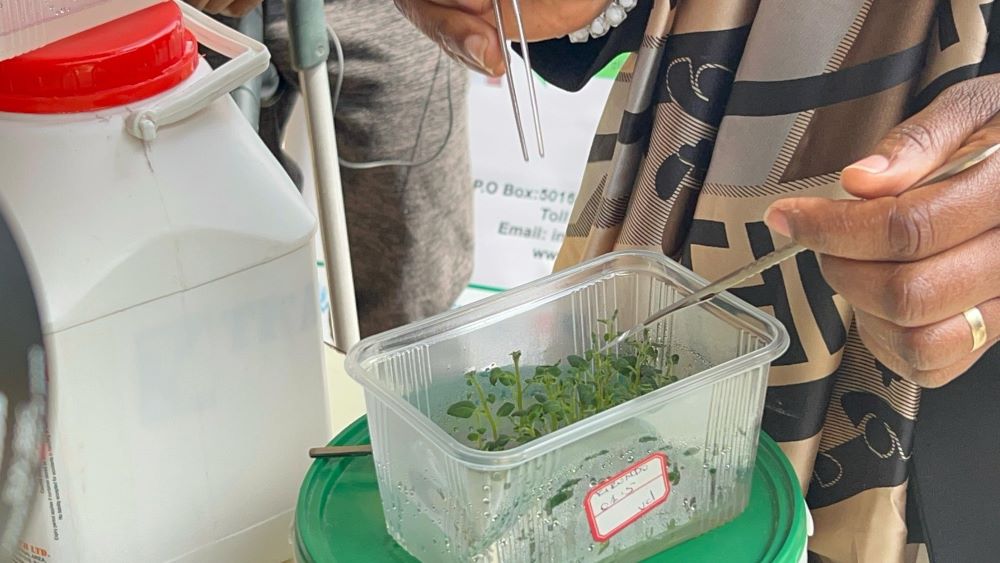
Musanze station, along with others such as Rwerere, Gakuta, Gishwati, and Nyamagabe, serves as a model for improving crop resilience against diseases and increasing yield. What makes Musanze unique is its ability to multiply seed potatoes (seed tubers) and process different varieties of potatoes.
According to Fidela Nikuze, the potato research coordinator at Rwanda Agriculture Board (RAB), she said: “We have a detailed list showing how basic seed potatoes are enhanced to increase disease resistance and reliability.”
This process begins with the first stage called G0, where advanced technology is used to produce seed tubers in a laboratory setting, ensuring they are free from pests and diseases.
Basic seed tubers (G0) are used to produce what are called minitubers, which are the foundation of seeds given to farmers. The production involves four main methods:
-
Conventional Screenhouse: Basic seed tubers are grown in specialized greenhouses, on sterilized soil treated with chemicals. This produces the first generation of seeds (Pre-basic seed).
-
Sandponic System: Tubers are planted in nutrient-enriched sand and treated with chemicals that eliminate pests and diseases. This method yields high-quality, sustainable seeds.
-
Aeroponic System: Tubers are grown in nutrient-rich water, where roots absorb nutrients without passing through soil. This produces high-quality seeds.
-
Direct Transfer: Basic seed tubers are first grown in nurseries and, after two weeks, transplanted to regular fields, producing the second generation of seeds (Basic seed).
Seeds given to farmers are classified into three categories: Basic seed, Certified seed, and Satisfactorily seed, depending on their quality and stage.
Nikuze continued: “We focus on Macro-elements, Micro-elements, vitamins, and hormones. These help the crop grow as if it were in soil, meaning we measure and adjust them to suit the soil characteristics.”
“The crop requires energy, and to grow, it needs sugar. We mix mineral nutrients with sugar using distilled water. Potatoes thrive at a pH close to 5.9.”
“After determining this pH with a meter, at 5.9, potato plants grow well even in water. To encourage root formation, we use ‘plant agar,’ which helps roots anchor.”
Once prepared this way, the crop is grown using the four methods mentioned above to produce minitubers. In this process, potatoes are not grown in soil but encouraged to root for anchorage.
Seed tubers are planted in suitable conditions to ensure healthy growth. They require alternating light and darkness, related to temperature and aeration: 16 hours of light, 8 hours of darkness, at 21 degrees Celsius. Within three to four weeks, the tubers are ready for capacity enhancement.
Pasifique Shimiyimana, an OFAB manager, said this research aims to combat various diseases caused by rain that greatly troubled farmers. He stated: “It was a disease causing farmers to lose about 40% of their production costs in buying and applying chemicals.”
He added: “This OFAB project, funded by ITF, aims to provide Rwandans with reliable information about this technology: how it works, its purpose, and when crops will be available.”
Farmers often wonder if seeds provided do not require chemical treatment. Shimiyimana replied: “Today, we have an answer. Enhanced potatoes are available, and once enhanced, they do not require chemicals.”
“Where potatoes are not enhanced, they get diseases. Yield can be less than 20% of what was expected.”
Shimiyimana explained the benefits of these potatoes for farmers and consumers: “For the farmer, there will be no need to buy or apply chemicals or hire workers for spraying. They will get higher yields. In the market, this will reduce prices because more potatoes will be available and thus sold cheaper.”
Seed certification plays a big role in increasing yields. Using reliable seeds raises production from 7-10 tons per hectare to 20-30 tons. This will enable the country to supply both domestic and export markets.
Dr. Athanase Nduwumuremyi, a researcher at RAB and leader of the OFAB project, said they are developing high-yield and affordable seed potatoes.
He said: “We are working on seeds that are easy to grow and enable potatoes to grow without needing excessive chemicals. Our method aims to produce potatoes resistant to all diseases caused by rain or sun.”
He concluded: “Since enhanced seeds do not require chemicals, and chemical inputs are costly, farming costs decrease. When crops mature without chemicals, farmers do not raise prices on the market, so consumers buy at lower prices.”
This method of seed potato production is expected to generate high and quality yields in agriculture. When farmers understand and follow this process well, they will be ready to face disease problems, losses, and low yields. Growing enhanced potatoes is an investment in better living standards for citizens, the country’s economy, and fighting hunger.