Ambassador Aurélie Royet-Gouin speaks on strengthening ties between France and Rwanda
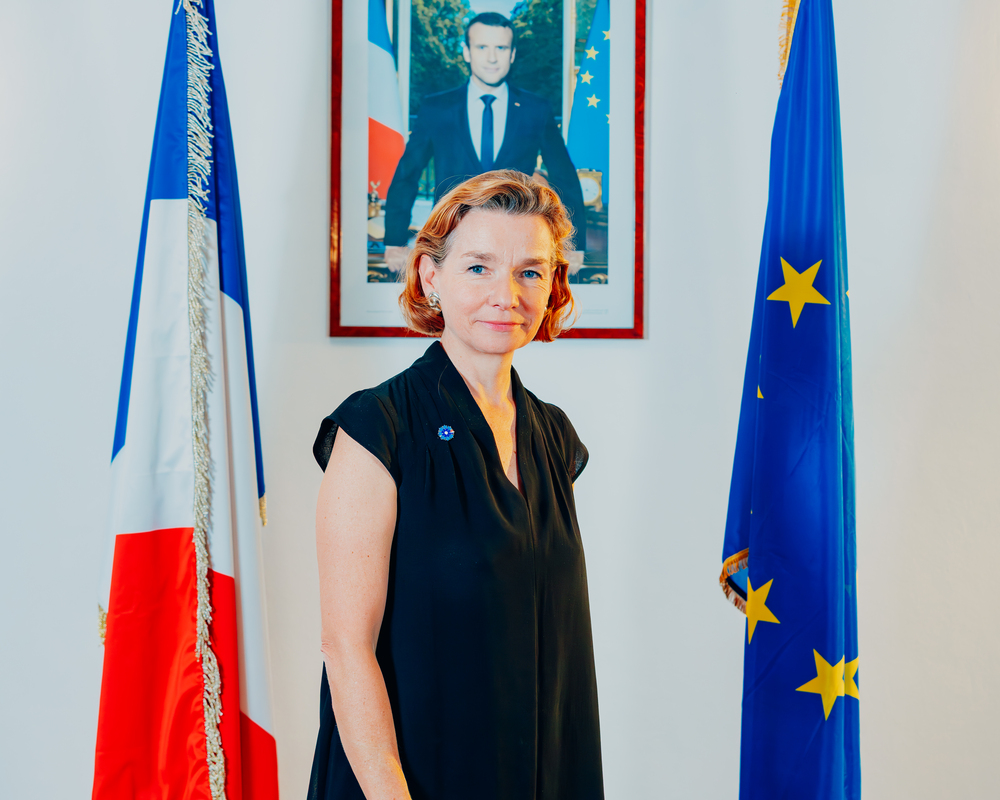
On July 15, 2025, French President Emmanuel Macron appointed Aurélie Royet-Gouin as France’s Ambassador to Rwanda, replacing Antoine Anfré, who had served in that position for four years. Nearly two months later, the new diplomat presented her credentials to President Paul Kagame, officially beginning her mission in Kigali.
It was an exceptional opportunity for Ambassador Aurélie, who had never set foot in the “Land of a Thousand Hills,” a country that has made remarkable progress in various sectors. However, it was not her first time serving in Africa, as she had previously worked in Kenya (2000–2003) and Senegal (2006–2009).
If someone had asked Ambassador Aurélie to name three or four distinctive things about Rwanda before taking up her new post, she admits it would have been difficult to answer.
Like many foreigners, her knowledge of Rwanda was rather general. Once she was appointed, she immediately sought to learn more by speaking with people familiar with the country and studying its context in depth.
She shared her reflections and priorities in an exclusive interview with IGIHE.
What did you know about Rwanda before your appointment?
Ambassador Aurélie Royet-Gouin: When I was appointed to Rwanda, I had never had the opportunity to visit before. It was a place I had heard about often. However, I have had the privilege of working extensively in Africa, so I already had a general idea of what diplomatic service here would entail. As you know, when you are given a diplomatic mission, you must come well-prepared.
There must be thorough preparation. Before coming, I met with many people in Paris — in ministries, public institutions, and organizations linked to Rwanda. I held numerous discussions to ensure I was fully ready for this new assignment.
What surprised you the most when you arrived in Rwanda?
I think what struck me most was Rwanda’s uniqueness. It is truly a distinct country. Of course, every nation has its own identity, but here, I found something remarkable — the landscape is breathtakingly beautiful, with endless green hills, and the atmosphere is unlike anywhere else I’ve been.
There is also a strong sense of purpose — people are focused, disciplined, and driven to achieve their goals. Rwandans are warm and polite, and one feels completely safe moving around. For a newcomer, it’s very moving to experience such hospitality and civility.
What are your priorities as France’s Ambassador to Rwanda?
I arrived at a very important time in our bilateral relations. As you know, our two countries began a process of reconciliation in 2021, rebuilding trust and cooperation. Restoring this relationship and establishing a new foundation required deep reflection from France and genuine openness from Rwanda.
Today, our partnership covers multiple sectors. As an Ambassador, I do not set my own policy — I implement that of my government. We have clear and shared objectives.
First, we will continue political dialogue with Rwanda, which is a key partner for France. We frequently consult each other on international issues — within the United Nations, La Francophonie, and other frameworks.
We also maintain close cooperation in the areas of history and justice, which lie at the heart of our reconciliation. France is committed to preserving the memory of Rwanda, especially the tragic events of 1994. This commitment is reflected in tangible actions such as historical research, the establishment of a memorial in Paris, and educational partnerships to ensure that French students learn about Rwanda’s history.
Justice is another pillar of our cooperation. France is firmly committed to fighting impunity and has prosecuted genocide suspects who sought refuge there. There is strong collaboration between France’s anti-terrorism prosecutor’s office and Rwanda’s judicial authorities. Trials are ongoing — one was concluded recently, and two new cases are expected in 2026. This continued judicial cooperation is highly valued.
We also work closely through the French Development Agency (AFD). In 2021, France provided €500 million, followed by an additional €400 million in 2024 for joint development projects — notably in health, such as the renovation of Ruhengeri Hospital, as well as vocational training and youth employment.
Our cooperation also promotes social cohesion through sports and community initiatives that align with Rwanda’s development agenda. Our focus areas include health, education, training, and climate resilience — all shared priorities for France and Rwanda.
France supports Rwanda’s efforts to combat climate change through financial aid and technical expertise provided by AFD and French specialists working alongside Rwandan institutions.
Are there any new French projects we should expect in Rwanda?
Yes, new projects are constantly being developed. We regularly meet our partners to implement the most urgent initiatives. One area we are revitalizing is French language education — by training teachers, accrediting bilingual schools, and improving the quality of French instruction. These remain major priorities for us.
You recently attended the humanitarian conference in Paris on October 30. Can you share anything beyond what was reported in the media?
(laughs) Well, there are no secrets — everything was public! French Minister Jean-Noël Barrot held a detailed press briefing alongside his Togolese counterpart, as the conference was co-organized by France and Togo, following the African Union’s mandate to Togo.
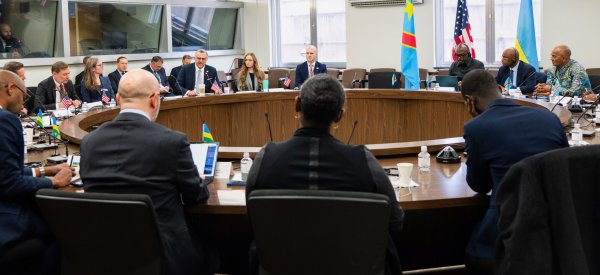
The meeting was not about negotiations but about mobilizing humanitarian support. It aimed to reinforce ongoing peace initiatives — including the Rwanda–DRC talks in Washington and the intra-Congolese dialogue in Doha.
As a permanent member of the UN Security Council, France wanted to reaffirm its commitment to international humanitarian law and to show that the global community supports peacebuilding efforts.
We also wanted to demonstrate that the world has not forgotten these crises or the affected populations — refugees, displaced persons, and civilians. Too often, people assume the international community has lost interest; we wanted to show otherwise.
The conference raised €1.5 billion, which will be used for humanitarian activities and post-conflict reconstruction in the region — a strong signal of support for the peace processes in Washington, Doha, and the African Union’s initiatives.
Later this month, Kigali will host the meeting of La Francophonie Foreign Ministers. What new developments can we expect, and what role will France play?
We are delighted that this meeting will be held in Rwanda, a strong member of La Francophonie. We also commend Secretary-General Louise Mushikiwabo for her excellent leadership.
The chosen theme — “Thirty Years After the Beijing Conference on Women’s Rights” — holds deep meaning for France, as gender equality is a cornerstone of our diplomacy.
La Francophonie is not just a cultural and linguistic space; it is also a growing economic and cooperative network, with nearly 700 million French speakers expected in the coming years, making French the fifth most spoken language in the world.
We fully support Rwanda’s decision to highlight women’s rights as the central theme.
Last month, France hosted a meeting of about 20 countries that advocate for a feminist foreign policy — Rwanda among them. The link between that initiative and the upcoming Kigali meeting underscores the importance of empowering women and promoting gender equality, particularly in peace and security efforts.
Thirty years after Beijing, the commitments made then remain relevant. As we approach the 2030 Sustainable Development Goals, much progress remains to be achieved. The Kigali meeting is therefore timely — it will renew political momentum and reinforce global commitments.
Rwanda stands out as a model: women’s representation in decision-making bodies speaks for itself, and the results are tangible. This country has shown that inclusive leadership drives true equality.
Hosting this meeting in Kigali, therefore, carries great significance. Rwanda’s diplomacy actively champions women’s rights and recognizes that gender equality must be central to all key discussions — from peacekeeping to governance.
France will be represented by Éléonore Caroit, our Minister for La Francophonie and International Cooperation. This meeting is also symbolic because France’s current chairmanship of the Francophonie Ministerial Council is coming to an end, and Cambodia will take over. It marks both continuity and transition.
France remains one of the largest contributors to La Francophonie and its institutions — a sign of our enduring commitment to international cooperation through this organization.
Finally, how do you balance your diplomatic duties with your personal experience of living in Rwanda?
You’re right — my main mission is to listen. As someone once said, “A wise person has attentive ears.” That’s my guiding principle. I want to meet as many people as possible across different walks of life, to hear and learn from them.
My role is not only to represent France but also to communicate clearly what we observe and understand from Rwanda.
And yes, I plan to travel across the country, meet diverse communities — and of course, enjoy Rwanda’s beautiful landscapes. I even brought my hiking shoes!