Rwanda’s unity and reconciliation rate reaches 95.3%, nearing 100%
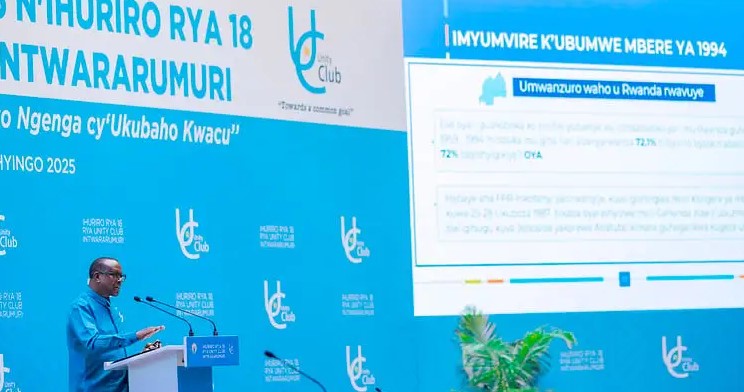
Dr. Jean Damascène Bizimana, the Minister of National Unity and Civic Engagement, has announced that Rwanda’s level of unity and reconciliation has reached 95.3%, a figure that is approaching full national cohesion.
He revealed that in 2025, the index increased by 13%, marking significant progress compared to previous years.
Dr. Bizimana made the announcement while addressing members of Unity Club Intwararumuri and other participants during the organization’s 18th annual forum, held on Saturday, November 8, 2025. He explained that the national survey on unity, reconciliation, and resilience is conducted every five years.
In 2020, the survey showed a 94.7% score. The latest study, conducted in 2025, involved 12,300 respondents from 8,100 households and 4,200 institutions across the country.
A total of 123 questions were asked, providing a detailed picture of the current state of unity and reconciliation. Among respondents, 52% were women and 48% were men; 47% were youth, while 53% were above 35 years old.
In terms of education, 38% had completed primary school, 26% secondary school, 21% had no formal education, 14% held university degrees, and 2% had vocational training.
“The unity index among Rwandans in 2025 stands at 95.3%, up from 82.3% in 2010. It was 92.5% in 2015 and 94.7% in 2020,” said Dr. Bizimana.
He added that resilience, as one of the key pillars of unity and reconciliation, currently stands at 90.8%.
According to the survey, 99.1% of respondents believe that Rwanda’s governance system is inclusive and non-discriminatory, while 99% agree that the country’s economic policies consider all social groups without exclusion.
Another 98.6% of respondents acknowledged that Rwanda promotes a culture of dialogue, peaceful conflict resolution, and consensus-based decision-making. Meanwhile, 98.1% believe citizens are well represented in decision-making bodies.
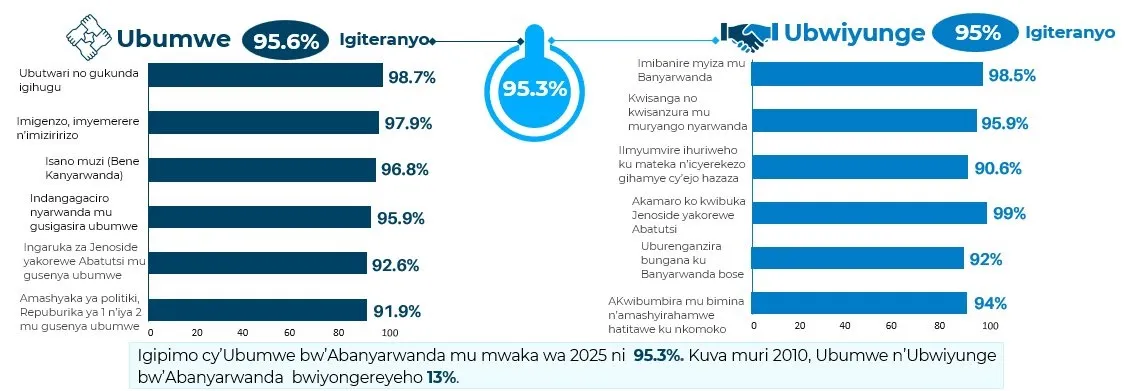
Overall, the findings show that national unity is at 95.6%, reconciliation at 95%, and resilience at 90.8%.
In addition, 97% of respondents agree that Rwanda’s leadership is inclusive and free of ethnic discrimination; 96% support teaching the nation’s history to young people, and 93% believe that all Rwandans have equal opportunities to enjoy their country’s benefits.
When asked about factors that undermined Rwanda’s unity in the past, 93% cited the divisive role of political parties such as Parmehutu and APROSOMA, while 93% mentioned the MDR party. The same percentage blamed intellectuals and elites for their role in planning the 1994 Genocide against the Tutsi, and 88% said that the youth were also involved.
According to the Ministry’s findings, the main factors that foster unity among Rwandans include patriotism and heroism (98.7%), shared cultural values and traditions (97.9%), a sense of belonging (96%), national values (95.9%), and lessons learned from the Genocide against the Tutsi (92.6%).
The survey also highlights the negative impact of pre-Genocide political parties, which accounted for 91.9% as a factor that once weakened unity.
Regarding reconciliation, the leading pillars include positive social relations (98.5%), a sense of belonging and freedom within the Rwandan community (95.9%), shared historical understanding (90.6%), and the importance of commemorating the Genocide against the Tutsi (99%).
All respondents (100%) said they are proud to be Rwandan and believe that the Kinyarwanda language is a powerful symbol of national unity. 98% acknowledged strong political will to promote unity, and a similar percentage expressed pride in the national heroes who liberated the country.
Moreover, 98% agreed that civic education programs such as Itorero and Ndi Umunyarwanda play an important role in strengthening national values. 99% confirmed that the Genocide against the Tutsi was planned, while 97% affirmed that Rwandanness (Ubunyarwanda) is the highest identity that defines them.